.svg)
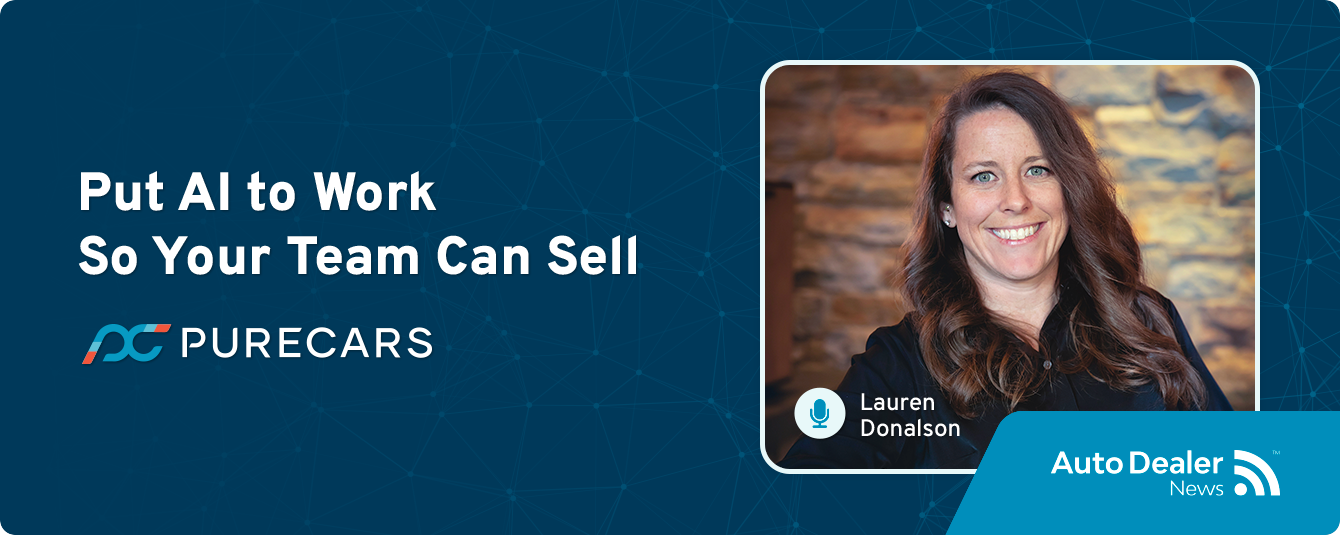
Put AI to Work So Your Team Can Sell
The conversation around AI in automotive has shifted—fast. What once felt experimental is now becoming essential. For dealerships navigating tighter margins, evolving customer expectations, and increasing regulatory scrutiny, AI isn’t just a trend—it’s a practical tool for running a smarter business.
In a recent conversation with Auto Dealer News, Lauren Donalson, CEO of PureCars, shared a grounded perspective on how dealers can actually put AI to work—without losing control of the customer experience.
From Skepticism to Standard Practice
AI adoption hasn’t always been smooth. Like many in the industry, Donalson admits her journey started with hesitation. Early tools were inconsistent, and real-world applications felt limited. That’s changed.
As AI systems have matured—fueled by better data and more intuitive interfaces—consumer behavior has shifted alongside them. Today’s shoppers are increasingly comfortable interacting with AI across their daily lives. That expectation doesn’t stop at retail.
“AI is a way of life for your customers,” Donalson explains. “It needs to be a way of life for your business as well.” For dealerships, the takeaway is simple: waiting is no longer a strategy.
AI Is Only as Strong as Your Data
The real power of AI doesn’t come from the technology alone—it comes from the data behind it.
With the recent acquisition of AutoAlert, PureCars has significantly expanded its data ecosystem. AutoAlert processes over 130 million personalized payments daily, adding scale and depth to AI-driven audience modeling and activation.
This matters because effective AI depends on clean, connected data. When data is accurate and actionable, dealerships can:
- Match customers with the right vehicles more effectively
- Activate campaigns across channels like paid search, social, OTT, and email
- Optimize spend toward the highest-converting audiences
In short, better data leads to better decisions—and better results.
Let AI Handle the Process—Not the Close
One of the biggest misconceptions about AI is that it replaces human interaction. In reality, the most effective strategies do the opposite: they protect it.
At PureCars, AI is used to streamline early-stage engagement—handling tasks like lead qualification and initial communication. But when it comes to closing the deal, the human element remains critical.
“Our AI agent does not negotiate,” Donalson notes.
That decision is intentional. It ensures:
- Compliance with increasing regulatory scrutiny around pricing
- Consistency in how offers are presented
- Trust in the final customer interaction
AI prepares the opportunity. Your team closes it.
A Smarter Use of Time and Talent
Perhaps the most immediate impact of AI is operational.
Dealership teams are often stretched thin, balancing lead response, follow-up, reporting, and customer engagement. AI and automation create an opportunity to rebalance that workload—freeing up time for higher-value activities.
Instead of asking whether AI will replace roles, dealerships should be asking a more practical question: Where can AI remove friction from the work we’re already doing?
That might mean:
- Automating repetitive outreach
- Prioritizing high-intent leads
- Streamlining campaign execution
- Reducing time spent on manual processes
The goal isn’t to do more—it’s to focus on what actually drives revenue.
What Comes Next: A Broader View of the Customer Journey
Looking ahead, AI’s role will expand beyond individual rooftops. Donalson points to a shift toward enterprise-level insights—where dealer groups and OEMs can analyze the full customer journey across multiple touchpoints. This broader perspective allows for:
- Faster path-to-purchase optimization
- More strategic allocation of marketing spend
- Stronger alignment between sales and marketing efforts
For dealerships, this means thinking beyond isolated systems and toward a more connected, data-driven operation.
Where to Start
For dealers still evaluating AI, the starting point doesn’t need to be complex.
Begin with your current processes:
- Where is your team spending the most time?
- Which tasks are repetitive or manual?
- Where are opportunities being missed or delayed?
From there, identify where AI and automation can support—not replace—your team. Because at its best, AI doesn’t change what dealerships do. It simply helps them do it better.
The bottom line: AI isn’t about replacing people—it’s about empowering them. When implemented thoughtfully, it creates space for your team to focus on what matters most: building relationships, earning trust, and closing deals.
Read the full interview here.

Book a meeting with us


Put AI to Work So Your Team Can Sell
The conversation around AI in automotive has shifted—fast. What once felt experimental is now becoming essential. For dealerships navigating tighter margins, evolving customer expectations, and increasing regulatory scrutiny, AI isn’t just a trend—it’s a practical tool for running a smarter business.
In a recent conversation with Auto Dealer News, Lauren Donalson, CEO of PureCars, shared a grounded perspective on how dealers can actually put AI to work—without losing control of the customer experience.
From Skepticism to Standard Practice
AI adoption hasn’t always been smooth. Like many in the industry, Donalson admits her journey started with hesitation. Early tools were inconsistent, and real-world applications felt limited. That’s changed.
As AI systems have matured—fueled by better data and more intuitive interfaces—consumer behavior has shifted alongside them. Today’s shoppers are increasingly comfortable interacting with AI across their daily lives. That expectation doesn’t stop at retail.
“AI is a way of life for your customers,” Donalson explains. “It needs to be a way of life for your business as well.” For dealerships, the takeaway is simple: waiting is no longer a strategy.
AI Is Only as Strong as Your Data
The real power of AI doesn’t come from the technology alone—it comes from the data behind it.
With the recent acquisition of AutoAlert, PureCars has significantly expanded its data ecosystem. AutoAlert processes over 130 million personalized payments daily, adding scale and depth to AI-driven audience modeling and activation.
This matters because effective AI depends on clean, connected data. When data is accurate and actionable, dealerships can:
- Match customers with the right vehicles more effectively
- Activate campaigns across channels like paid search, social, OTT, and email
- Optimize spend toward the highest-converting audiences
In short, better data leads to better decisions—and better results.
Let AI Handle the Process—Not the Close
One of the biggest misconceptions about AI is that it replaces human interaction. In reality, the most effective strategies do the opposite: they protect it.
At PureCars, AI is used to streamline early-stage engagement—handling tasks like lead qualification and initial communication. But when it comes to closing the deal, the human element remains critical.
“Our AI agent does not negotiate,” Donalson notes.
That decision is intentional. It ensures:
- Compliance with increasing regulatory scrutiny around pricing
- Consistency in how offers are presented
- Trust in the final customer interaction
AI prepares the opportunity. Your team closes it.
A Smarter Use of Time and Talent
Perhaps the most immediate impact of AI is operational.
Dealership teams are often stretched thin, balancing lead response, follow-up, reporting, and customer engagement. AI and automation create an opportunity to rebalance that workload—freeing up time for higher-value activities.
Instead of asking whether AI will replace roles, dealerships should be asking a more practical question: Where can AI remove friction from the work we’re already doing?
That might mean:
- Automating repetitive outreach
- Prioritizing high-intent leads
- Streamlining campaign execution
- Reducing time spent on manual processes
The goal isn’t to do more—it’s to focus on what actually drives revenue.
What Comes Next: A Broader View of the Customer Journey
Looking ahead, AI’s role will expand beyond individual rooftops. Donalson points to a shift toward enterprise-level insights—where dealer groups and OEMs can analyze the full customer journey across multiple touchpoints. This broader perspective allows for:
- Faster path-to-purchase optimization
- More strategic allocation of marketing spend
- Stronger alignment between sales and marketing efforts
For dealerships, this means thinking beyond isolated systems and toward a more connected, data-driven operation.
Where to Start
For dealers still evaluating AI, the starting point doesn’t need to be complex.
Begin with your current processes:
- Where is your team spending the most time?
- Which tasks are repetitive or manual?
- Where are opportunities being missed or delayed?
From there, identify where AI and automation can support—not replace—your team. Because at its best, AI doesn’t change what dealerships do. It simply helps them do it better.
The bottom line: AI isn’t about replacing people—it’s about empowering them. When implemented thoughtfully, it creates space for your team to focus on what matters most: building relationships, earning trust, and closing deals.
Read the full interview here.

Book a meeting with us
More stories
.png)
Stay Connected
Subscribe for PureCars updates.

