.svg)
The End of Disconnected Data: What PureCars + AutoAlert Means for Automotive Retail
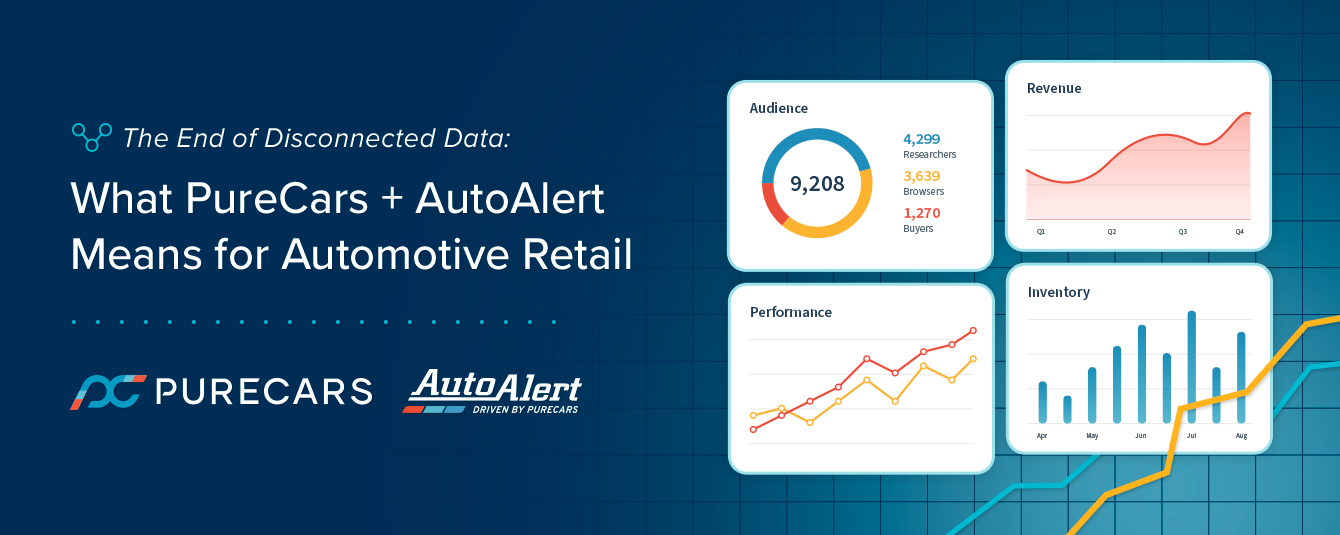
If you work at a dealership, you've probably felt this pain firsthand: your DMS knows one thing about a customer, your CRM knows another, your service department has its own record, and your website analytics are sitting in a completely separate silo. Somewhere in that mess is a customer who's ready to buy — but nobody sees the full picture in time to act on it.
That's the problem PureCars' acquisition of AutoAlert is designed to solve. And while any acquisition announcement can sound like corporate housekeeping, this one is worth understanding — because it reflects a shift the entire industry has been circling for years: data alone isn't the advantage anymore. Connected, actionable data is.
The Problem: Dealers Already Have the Data. It's Just Disconnected.
Most dealerships aren't short on customer information. Between the DMS, CRM, service history, equity data, website behavior, and third-party sources, dealers are sitting on a genuinely rich data set.
The problem is that these systems don't talk to each other. A customer's service visit doesn't inform the marketing team's ad targeting. A trade-in opportunity flagged by predictive data mining doesn't automatically trigger a sales follow-up. The result is predictable:
- Missed sales — because the buying signal existed, but no one saw it in time
- Duplicate marketing — because the same customer is targeted by multiple disconnected campaigns
- Poor customer experience — because messaging is inconsistent across departments
- Wasted ad spend — because dealers are advertising to everyone, not the people most likely to actually buy
Individually, most dealership tech stacks are good at storing and reporting. Very few are good at knowing what to do next.
Two Companies, Two Different (and Complementary) Strengths
This is where the acquisition logic becomes clear. PureCars and AutoAlert weren't competing with each other — they were solving two different halves of the same problem.
AutoAlert has spent 20+ years perfecting predictive data science for automotive retail. Its core strength is timing: identifying which customers are most likely to buy, trade, service, or re-engage, and automatically notifying dealership teams when to reach out.
PureCars has spent 19 years as a leader in automotive digital advertising and customer data activation — the #1 platform in media under management across Google, Meta, and Amazon, and a pioneer in turning cleansed, consolidated customer data into actual ad campaigns that drive measurable ROI.
Put simply:
- AutoAlert knows when to engage.
- PureCars knows who the customer is and how to reach them.
Alone, each platform informs. Together, they act. That distinction — information versus action — is the entire premise behind combining them into a single Customer Growth Platform.
Why This Matters for the Industry as a Whole
This acquisition isn't just two vendors combining product lines. It reflects a broader trend reshaping automotive retail: the shift from point solutions to unified platforms.
For years, dealers have accumulated a growing stack of specialized tools — one for predictive insights, one for ad management, one for CRM workflows, one for identity resolution. Each tool does its job well in isolation, but the seams between them are where value leaks out. A prioritized opportunity that never reaches a marketing campaign. A high-value customer who gets a generic ad instead of a personalized offer. A service customer who's ready to trade but never gets flagged to sales.
By merging predictive intelligence (AutoAlert) with data activation and advertising (PureCars), the combined platform closes those seams. It represents a broader industry realization: dealers don't need more data — they need one connected intelligence layer that turns existing data into consistent action across every department.
This also sets a competitive bar. As dealer groups scale and margins tighten, platforms that can demonstrate a clear, closed loop — identify an opportunity, prioritize it, activate it, and measure the result — will have a structural advantage over vendors offering only one piece of that loop.
What This Actually Means for Dealers
Beyond the strategic narrative, here's what dealers can expect in practice:
1. One customer profile instead of six disconnected ones. Every touchpoint — DMS, CRM, service, web, equity, and third-party data — is consolidated into a single, cleansed customer record. No more guessing which system has the "real" picture of a customer.
2. Continuous, automated opportunity detection. Instead of manual list pulls and static reports, the combined platform continuously scans for buying signals — a customer's equity position changing, a service visit pattern suggesting a trade is coming, a lease nearing maturity — and surfaces them automatically.
3. Automated activation, not just alerts. Historically, predictive tools have been good at telling a dealer what to do — but the follow-through still depended on a salesperson remembering to make the call, or a marketing team manually building a campaign. Now, once an opportunity is identified, it can automatically trigger the right marketing action — a targeted ad, a personalized offer, a sales team notification — without manual intervention.
4. Smarter, more efficient advertising spend. Rather than advertising broadly to "everyone" in a market, dealers can target the customers and prospects statistically most likely to buy.
5. A more consistent customer experience. When sales, service, and marketing are all working from the same customer intelligence, the customer notices. Fewer redundant offers, more relevant communication, and consistent messaging regardless of which department they're interacting with.
6. AI that turns data into action. AI adds another layer of intelligence to the platform, helping dealers identify predictive buyer signals, build AI-driven audiences, recognize patterns across customer data, and determine which customers are most likely to be in-market. Instead of simply reporting on what happened, AI helps dealers anticipate what could happen next — and act on those opportunities.
7. Measurable outcomes tied to revenue, not just activity. The platform is explicitly built around outcomes — increased revenue through better conquest, retention, service revenue, and repeat purchases; increased efficiency by eliminating manual processes; and a better customer experience — rather than simply reporting on activity metrics.
The Bigger Picture
Dealers have never lacked data. What's been missing is a system that knows what to do with it — in real time, across every department, without requiring someone to manually connect the dots.
The PureCars + AutoAlert combination is a bet that the next competitive advantage in automotive retail won't come from having more data, but from having one connected engine that knows who your customers are, when they're ready to act, and how to reach them — automatically, and at scale.
For an industry that's spent the last decade stitching together point solutions, that's a meaningful shift — and a good moment for dealers to take a closer look at what a truly connected platform could mean for their own growth. If you're curious how this could work for your dealership, request a demo to see it in action

Book a meeting with us


The End of Disconnected Data: What PureCars + AutoAlert Means for Automotive Retail
If you work at a dealership, you've probably felt this pain firsthand: your DMS knows one thing about a customer, your CRM knows another, your service department has its own record, and your website analytics are sitting in a completely separate silo. Somewhere in that mess is a customer who's ready to buy — but nobody sees the full picture in time to act on it.
That's the problem PureCars' acquisition of AutoAlert is designed to solve. And while any acquisition announcement can sound like corporate housekeeping, this one is worth understanding — because it reflects a shift the entire industry has been circling for years: data alone isn't the advantage anymore. Connected, actionable data is.
The Problem: Dealers Already Have the Data. It's Just Disconnected.
Most dealerships aren't short on customer information. Between the DMS, CRM, service history, equity data, website behavior, and third-party sources, dealers are sitting on a genuinely rich data set.
The problem is that these systems don't talk to each other. A customer's service visit doesn't inform the marketing team's ad targeting. A trade-in opportunity flagged by predictive data mining doesn't automatically trigger a sales follow-up. The result is predictable:
- Missed sales — because the buying signal existed, but no one saw it in time
- Duplicate marketing — because the same customer is targeted by multiple disconnected campaigns
- Poor customer experience — because messaging is inconsistent across departments
- Wasted ad spend — because dealers are advertising to everyone, not the people most likely to actually buy
Individually, most dealership tech stacks are good at storing and reporting. Very few are good at knowing what to do next.
Two Companies, Two Different (and Complementary) Strengths
This is where the acquisition logic becomes clear. PureCars and AutoAlert weren't competing with each other — they were solving two different halves of the same problem.
AutoAlert has spent 20+ years perfecting predictive data science for automotive retail. Its core strength is timing: identifying which customers are most likely to buy, trade, service, or re-engage, and automatically notifying dealership teams when to reach out.
PureCars has spent 19 years as a leader in automotive digital advertising and customer data activation — the #1 platform in media under management across Google, Meta, and Amazon, and a pioneer in turning cleansed, consolidated customer data into actual ad campaigns that drive measurable ROI.
Put simply:
- AutoAlert knows when to engage.
- PureCars knows who the customer is and how to reach them.
Alone, each platform informs. Together, they act. That distinction — information versus action — is the entire premise behind combining them into a single Customer Growth Platform.
Why This Matters for the Industry as a Whole
This acquisition isn't just two vendors combining product lines. It reflects a broader trend reshaping automotive retail: the shift from point solutions to unified platforms.
For years, dealers have accumulated a growing stack of specialized tools — one for predictive insights, one for ad management, one for CRM workflows, one for identity resolution. Each tool does its job well in isolation, but the seams between them are where value leaks out. A prioritized opportunity that never reaches a marketing campaign. A high-value customer who gets a generic ad instead of a personalized offer. A service customer who's ready to trade but never gets flagged to sales.
By merging predictive intelligence (AutoAlert) with data activation and advertising (PureCars), the combined platform closes those seams. It represents a broader industry realization: dealers don't need more data — they need one connected intelligence layer that turns existing data into consistent action across every department.
This also sets a competitive bar. As dealer groups scale and margins tighten, platforms that can demonstrate a clear, closed loop — identify an opportunity, prioritize it, activate it, and measure the result — will have a structural advantage over vendors offering only one piece of that loop.
What This Actually Means for Dealers
Beyond the strategic narrative, here's what dealers can expect in practice:
1. One customer profile instead of six disconnected ones. Every touchpoint — DMS, CRM, service, web, equity, and third-party data — is consolidated into a single, cleansed customer record. No more guessing which system has the "real" picture of a customer.
2. Continuous, automated opportunity detection. Instead of manual list pulls and static reports, the combined platform continuously scans for buying signals — a customer's equity position changing, a service visit pattern suggesting a trade is coming, a lease nearing maturity — and surfaces them automatically.
3. Automated activation, not just alerts. Historically, predictive tools have been good at telling a dealer what to do — but the follow-through still depended on a salesperson remembering to make the call, or a marketing team manually building a campaign. Now, once an opportunity is identified, it can automatically trigger the right marketing action — a targeted ad, a personalized offer, a sales team notification — without manual intervention.
4. Smarter, more efficient advertising spend. Rather than advertising broadly to "everyone" in a market, dealers can target the customers and prospects statistically most likely to buy.
5. A more consistent customer experience. When sales, service, and marketing are all working from the same customer intelligence, the customer notices. Fewer redundant offers, more relevant communication, and consistent messaging regardless of which department they're interacting with.
6. AI that turns data into action. AI adds another layer of intelligence to the platform, helping dealers identify predictive buyer signals, build AI-driven audiences, recognize patterns across customer data, and determine which customers are most likely to be in-market. Instead of simply reporting on what happened, AI helps dealers anticipate what could happen next — and act on those opportunities.
7. Measurable outcomes tied to revenue, not just activity. The platform is explicitly built around outcomes — increased revenue through better conquest, retention, service revenue, and repeat purchases; increased efficiency by eliminating manual processes; and a better customer experience — rather than simply reporting on activity metrics.
The Bigger Picture
Dealers have never lacked data. What's been missing is a system that knows what to do with it — in real time, across every department, without requiring someone to manually connect the dots.
The PureCars + AutoAlert combination is a bet that the next competitive advantage in automotive retail won't come from having more data, but from having one connected engine that knows who your customers are, when they're ready to act, and how to reach them — automatically, and at scale.
For an industry that's spent the last decade stitching together point solutions, that's a meaningful shift — and a good moment for dealers to take a closer look at what a truly connected platform could mean for their own growth. If you're curious how this could work for your dealership, request a demo to see it in action

Book a meeting with us
More stories


Stay Connected
Subscribe for PureCars updates.

